Why Your AC Cools Fine in June and Struggles by August
The thermostat says the same number all summer. The system behind it is working a lot harder to hit it in August than it was in June.
August 25, 2026 · 3 min read
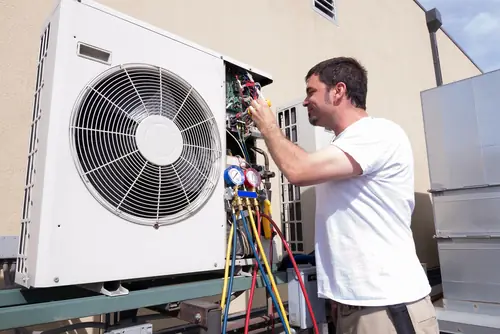
In June, a Magnolia or Woodlands home usually feels fine. The AC clicks on, the house cools down, and nobody thinks about it again until August, when the same system suddenly can't seem to keep up. The set point on the thermostat hasn't moved. The equipment hasn't changed. What's changed is the load the system is being asked to carry, and that load doesn't rise in a straight line with the outside temperature.
Heat load climbs faster than the thermometer does
A jump from 85 to 95 degrees outside doesn't add ten degrees' worth of extra work indoors, it adds a lot more than that. The difference between inside and outside temperature is what drives how hard a compressor has to run, and as that gap widens, the system spends more of every hour running instead of cycling off. A unit that looked adequate in June, cycling on and off comfortably, can end up running almost continuously by late July with no mechanical failure anywhere in it. It's simply being asked to move more heat, more often, for longer stretches.
Humidity is doing work the thermostat doesn't measure
Along Houston's northern edge, summer humidity adds a second job to the same system. An air conditioner cools air and pulls moisture out of it at the same time, and high humidity means more of that moisture has to be removed before a house actually feels comfortable. Two homes at the identical 75 degrees on the thermostat can feel completely different depending on how much humidity the system has managed to strip out. In peak summer, that extra dehumidification competes with straight cooling for the same equipment capacity, which is part of why a system that felt strong in spring can feel like it's barely keeping pace in August even though the number on the thermostat hasn't moved.
A system sized for spring isn't automatically sized for peak summer
Every AC system is sized against a design temperature, an assumption about how hot it will realistically get in this climate. A unit that's slightly undersized, or that's lost some capacity over the years through wear, will often mask that gap in mild weather and expose it the moment outdoor temperatures push toward the top of the range. That's not always a sign something is broken. Sometimes it's a sign the equipment is at the edge of what it was built to do, and worth having looked at before assuming a bigger repair is coming.
Short cycling makes the problem worse, not better
When a system that's already struggling starts shutting off and restarting more often than usual, that's short cycling, and it's worth paying attention to rather than working around. Short cycling puts extra wear on the compressor, wastes energy, and often signals a refrigerant issue, a dirty coil, or an airflow restriction rather than a system that's simply getting old. Left alone through a full Texas summer, it tends to turn a minor issue into a bigger one by September.
What to check before assuming the worst
- Air filter held up to a light. If you can't see through it, restricted airflow is doing more damage than the heat is
- Outdoor unit fins clear of grass clippings, leaves, and anything blocking airflow around the condenser
- Vents inside the house open and not blocked by furniture or rugs
- Thermostat batteries, if it takes them, before assuming a bigger fault
- Ice on the indoor coil or refrigerant lines, which means turn the system off and call rather than run it
Why the spring visit matters more than it seems
A lot of what shows up as an August emergency was visible in April, if someone was looking. Weak refrigerant charge, a coil that's slowly losing efficiency, electrical connections that have loosened from a year of heat cycling, all of it tends to progress slowly enough that it's easy to miss until the hottest week of the year forces the issue. Prestige Heating and Air Conditioning runs maintenance visits twice a year, in spring and fall, built around catching exactly this kind of thing before it becomes a no-cool call in August.
Prestige Heating and Air Conditioning services Magnolia, The Woodlands, and Conroe, and is available 24 hours a day, seven days a week. They offer a free quote on replacement or new installation if a system is closer to the end of its life than the beginning. Call (281) 288-6211.
Prestige Heating and Air Conditioning. (281) 288-6211
Call (281) 288-6211More articles
What Actually Fails on Your Outdoor Condenser
The unit outside your house does more moving and more heat cycling than almost anything else on the property, and it shows.
Where the Cooling You Paid For Goes: Ductwork in a Houston Attic
A system can be running perfectly and a house can still feel uneven, because the problem isn't the equipment, it's everything between the equipment and the room.