What Actually Fails on Your Outdoor Condenser
The unit outside your house does more moving and more heat cycling than almost anything else on the property, and it shows.
August 25, 2026 · 4 min read
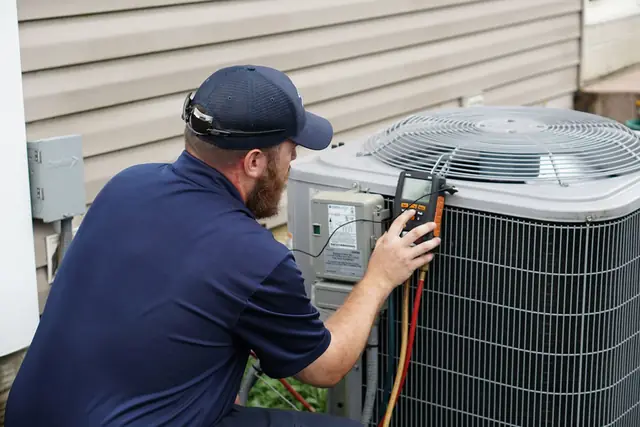
The outdoor unit, the condenser, takes the brunt of a Texas summer. It sits in direct sun, runs for hours at a stretch during peak heat, and cycles on and off thousands of times over a season. When something goes wrong with a home's cooling, there's a good chance it starts here rather than inside the house.
The capacitor is usually the first thing to go
A run capacitor gives the compressor and outdoor fan motor the jolt of energy they need to start and keep running smoothly. Heat wears capacitors down the same way it wears down a car battery, faster with every hot season. A weak capacitor often shows up as a humming sound from the outdoor unit with the fan not turning, or a system that trips off a few minutes after it starts. It's a small part, and replacing one is usually a fast job for a licensed technician, not a sign the whole unit is failing.
Contactors and electrical connections loosen with heat cycling
Every time a condenser starts and stops, its electrical contacts open and close. Over thousands of cycles across a Texas summer, those connections can pit, corrode, or loosen, and a failing contactor can leave a system that won't start at all, or one that keeps running after the thermostat calls for it to stop. This is exactly the kind of fault a manifold gauge set and a multimeter catch quickly, and exactly the kind that's not safe to chase yourself with the panel open.
Refrigerant leaks show up as ice, not as an obvious drip
Low refrigerant from a slow leak rarely looks like a leak. It usually looks like ice building up on the indoor coil or the lines, weak airflow at the vents, or a system that runs constantly without the house ever quite reaching temperature. Refrigerant work is regulated for good reason, and charging a system without finding the actual leak first just delays the real repair. If you see frost or ice anywhere on the lines, shut the system off, let it thaw fully, and call before running it again.
A dirty condenser coil is the easiest fix and the easiest thing to ignore
The coil wrapped around the outdoor unit has to move heat out of the refrigerant and into the outside air, and it can't do that efficiently if it's caked in grass clippings, cottonwood fluff, or a season of dust. A restricted coil makes the whole system work harder for less result, and it's one of the few things on a condenser a homeowner can genuinely help with, by keeping clippings and yard debris away from the unit and making sure nothing is stacked or planted close enough to block airflow.
What a service call actually looks like
The approach on a repair call is diagnostic first: find out what's actually wrong before talking about a fix, and look for a repair that gets a working system back rather than jumping straight to replacement. That shows up in customer reviews too, technicians tracing a problem to its real cause, such as a thermal expansion valve that had never been installed correctly, rather than guessing at parts to swap.
Most of this is preventable with regular maintenance
A capacitor that's starting to weaken, a contactor that's starting to pit, a refrigerant charge that's slowly dropping from a small leak, all of it shows up as a small change in readings before it causes an outage. A maintenance visit that checks capacitor output, tightens electrical connections, and measures refrigerant pressure catches most of this while it's still a quick fix rather than an emergency. A condenser that gets looked at before the heat arrives is a lot less likely to fail during it, which is the entire logic behind running a tune-up in spring rather than waiting for a hot afternoon to force the issue.
When repeated repairs are telling you something
A condenser that needs a second service call for a different part within the same season isn't necessarily failing outright, but it's worth a closer look rather than another one-off fix. Sometimes it's coincidence, an old capacitor and an unrelated wiring issue happening to land in the same summer. Sometimes it's a pattern, a system old enough that parts are starting to fail in sequence as they each reach the end of their working life. A technician who's seen the full service history can usually tell you which situation you're in, and that's worth asking about directly rather than treating each call as unrelated to the last.
Signs worth a call sooner rather than later
- Humming from the outdoor unit with no fan movement
- The system tripping the breaker more than once
- Ice on the lines or the indoor coil
- A noticeable jump in the electric bill with no change in how the system's being used
- Warm air blowing from vents that used to run cold
Prestige Heating and Air Conditioning is licensed and insured, works on all brands of equipment, and is available 24 hours a day for calls like these. Owner Brian Gesner and the team serve Magnolia, The Woodlands, and Conroe. Call (281) 288-6211 for a diagnosis.
Prestige Heating and Air Conditioning. (281) 288-6211
Call (281) 288-6211More articles
Why Your AC Cools Fine in June and Struggles by August
The thermostat says the same number all summer. The system behind it is working a lot harder to hit it in August than it was in June.
Where the Cooling You Paid For Goes: Ductwork in a Houston Attic
A system can be running perfectly and a house can still feel uneven, because the problem isn't the equipment, it's everything between the equipment and the room.